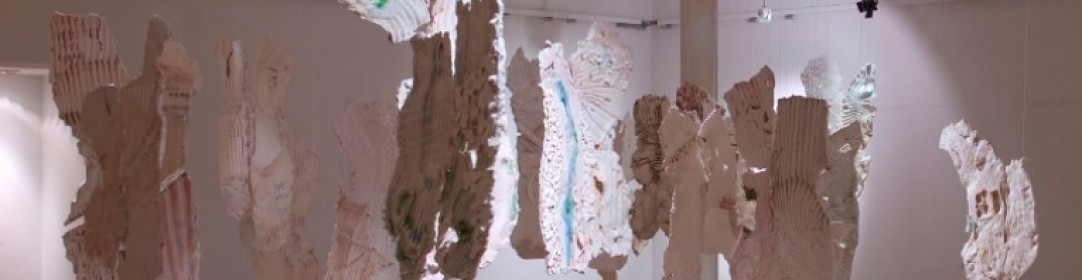
The Verticals
 The ‘verticals’ are a body of sculptural works made in 2001, developed through an extended conceptual and material investigation into verticality as an idea of uprightness, ascent, line, and bodily extension. The final pieces were not modelled in the round but cut away from a prepared bed of white grogged stoneware clay. The clay was laid out as a horizontal field, described as a ‘tomb-like’ surface, from which forms were extracted rather than constructed. They were then lifted onto prepared cardboard tubes from butter-soft to dry slowly into the shape of a segment of a cylinder about one metre tall.
A specially designed wire tool, slightly less than a foot in width and shaped with crinkled edges, was used to cut into the soft clay to create sharp grooves. The process required the maker to lean forward and extend the body to its maximum unaided reach. This established a direct relation between bodily limits and the scale of each extracted form. The works therefore embed a precise relation between human reach, material resistance, and spatial definition.
A central conceptual contradiction underpins the series. The works pursue verticality within a material that cannot sustain upright form in its initial state. Soft clay, by definition, resists standing and requires transformation through drying and firing. This tension between idea and material condition is not resolved in advance but negotiated through process. The vertical becomes not a stable object but a trace of an intention extracted from a resistant field.
Raku firing was integral to the later stages of the process, creating surface dynamics and a sense of material history. After a glaze wash, the works were subjected to extreme thermal conditions of approximately 1000 degrees Celsius and removed by hand during post-firing reduction and oxidation. This required direct physical engagement with the kiln environment, using protective equipment and without reliance on a technician. The act of extraction and excavation is therefore part of the work’s ontology and inner life, embedding risk, timing, and bodily responsibility within its making.
The works were received at the time as sensitive, archaic, and modern, reflecting their simultaneous engagement with bodily gesture, historical resonance, and abstract form. A scholarship was awarded in recognition of this body of work, confirming its intellectual coherence within its originating context.
The artist describes the works as an extension of the self, in the sense that they embody ambition, cognitive intensity, and bodily procedure at a specific moment in time. The breath and the cutting tool become one in the extraction of the pieces, where any tremor could result in twist or collapse. The resulting columns thus become material records of a sustained alignment between idea, action, and constraint. The practice is structured by an internal ethical demand for coherence rather than external validation. Success is understood primarily as alignment between intention, process, and outcome under given circumstances, rather than external recognition alone.
There is a continuing concern for the preservation and future care of the works. As fragile ceramic objects produced through complex firing processes, their long-term survival depends upon informed custodianship. The primary concern is not institutional status but that the works are neither damaged nor discarded in future transitions of ownership. They require recognition as authored objects with specific procedural histories.
The works remain active within the domestic environment in which they are held currently, continuing to operate as material expressions of a specific intellectual and bodily phase of practice.
Notes on Conceptual and Artistic Contexts
The works stand for the struggle to remain upright, they resonate with a number of philosophical, sculptural, and material traditions concerned with embodiment, process, spatial orientation, fragility, and the archaeology of memory. These references are not presented as direct influences in every case, but as intellectual and artistic contexts within which the work may be situated.
• Maurice Merleau-Ponty (1908–1961)
French phenomenological philosopher whose writings on embodiment, perception, gesture, and bodily orientation are relevant to the works’ emphasis on reach, breath, movement, and spatial relation.
• Gaston Bachelard (1884–1962)
French philosopher and literary theorist associated with the poetics of space, verticality, memory, and intimate environments. Particularly relevant to the imaginative and spatial dimensions of the domestic setting and the symbolic resonance of ascent.
• Martin Heidegger (1889–1976)
German philosopher concerned with material presence, “thingness”, dwelling, and the relation between making and being. Relevant to the understanding of the works as active presences rather than inert objects.
• Eva Hesse (1936–1970)
German-born American sculptor associated with Post-Minimalism and process-based sculpture. Relevant through her engagement with fragility, vulnerability, material instability, and bodily resonance.
• Antony Gormley (born 1950)
British sculptor whose work investigates the body as spatial measure and existential presence. Relevant to the relationship between bodily extension, verticality, and orientation within space.
• Post-Minimalism
An artistic movement emerging in the late 1960s which shifted attention from fixed geometric form towards process, contingency, gravity, repetition, and material behaviour. Relevant to the procedural and unstable nature of the clay forms.
• Phenomenology
A philosophical tradition concerned with lived experience and embodied perception. Relevant to the integration of bodily action, breath, balance, and spatial awareness within the making process.
• Process-based Sculpture
A sculptural approach in which process, transformation, instability, and temporal change are integral to meaning. Relevant to the extraction, drying, firing, and Raku procedures central to the works.
• Raku
A ceramic firing tradition originating in Japan, associated with direct handling, unpredictability, reduction, and surface transformation. Relevant both materially and conceptually to the works’ engagement with heat, risk, and surface history.
• Archaeological Poetics
A conceptual framework concerned with fragments, excavation, traces, remnants, and layered histories. Particularly relevant to both “The Verticals” and the later body of work entitled “The Archaeology of Self”.