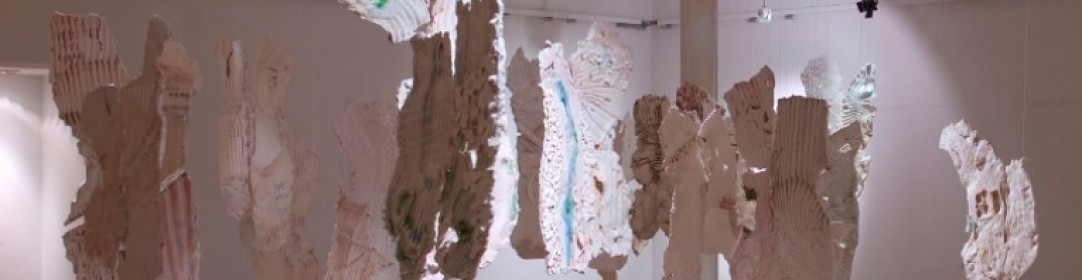
The Orange Monument
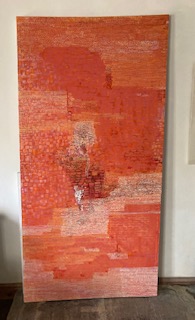
Oil on canvas 1.5 x 2.20 metres
The orange monument emerged without prior programme or illustrative intention. I had visited Estakhr near Apadana in Persepolis some time back and had a sense of wonder about its history and habitus, and the obscured remains of one or two half buried marble slabs with thousands of scattered shards disclosing richness and history. I did not set out to paint this however, nor to construct an archaeological scene in any literal sense. The work developed in my head for some time as an idea and eventually my large canvas became the site for accumulation and interruption of marks: layering, removal, return. Forms seemed to negotiate their own presence, much like a script, rather than obey a fixed compositional plan. In retrospect, I do not fully author any of my works in advance. I negotiate with them as they appear, and only afterwards begin to interpret what has occurred. I do however know that whether I write, paint, sculpt, or design, I engage with the archaeology of my Self in essence.
The painting carries monumentality, though approached with caution. Not as heroism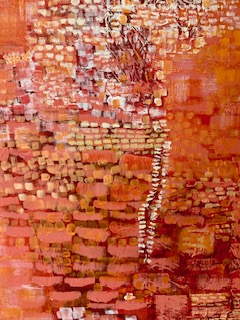 or spectacle, but as endurance of presence: forms that appear simultaneously ancient and unfinished, emerging and withdrawing within the same field. Vertical structures hold a weight closer to ruin or stelae rather than architecture. Their relations suggest gathering and separation at once. Readings offered by others—graves, or the aura of a beast—are not intentional, yet remain viable within the internal logic of the work and mark making.
Ambiguity here is not added meaning but structural condition. The painting resists resolution into narrative or icon, it is not representational. It is formed through excavation as much as construction: repeated working, partial erasure, persistence of earlier states beneath later decisions. It behaves archaeologically, not as subject but as method—where what is buried remains active within what appears. This is important in my work.
Colour is not descriptive but operative. The orange carries incompatible associations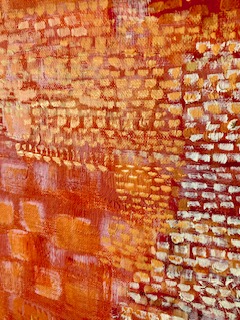 —heat, light, oxidation, earth, bodily warmth, fired matter—without settling into any single register. It produces instability in the monumentality of form, preventing closure into fixed reading. Light is not neutral visibility but an active force within the work. This is important to me. It shifts legibility, alters depth, intermittently erodes or consolidates structure. The painting is therefore not seen once but continuously re-composed through internal illumination, as if meaning were being re-written in real time between matter and light.
The making itself was not continuous assurance. Brushwork and surface carried resistance. There were points of doubt, even ridicule, where the act of painting felt exposed rather than authoritative. These moments were not interruptions but constitutive pressure points: where control loosened, and decisions became less declarative, more instinctive, dependent on return rather than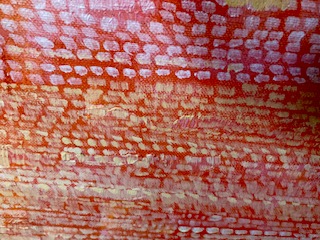 certainty. In this sense, the orange monument which I have come to associate with the qualities, remembered and constructed, of Estakhr with trace and residue. It belongs to a practice in which meaning is not fully declared but sedimented. The work does not explain itself directly. It holds together fragments in surface marks, and of memory, ruin, architecture, bodily scale and imagined history within a field where appearance and disappearance coexist. I hope thinking continues inside the painting without commentary but as something embedded in its making and reactivated in its viewing.
Selected Theoretical Contexts
- Maurice Merleau-Ponty — embodied perception; painting as discovery rather than illustration; the visible as something that emerges through engagement.
- Tim Ingold — making as a process of correspondence between maker and material, where form develops through practice rather than prior design.
- Michael Shanks — archaeology understood as an interpretive and stratigraphic practice; excavation as method rather than merely subject matter.
- Palimpsest — layered inscription in which earlier traces remain active within later surfaces; a useful conceptual model for thinking about accumulation, erasure and persistence.
- Phenomenology — the artwork understood as an event of perception and experience, rather than as representation.